By Esther Williams

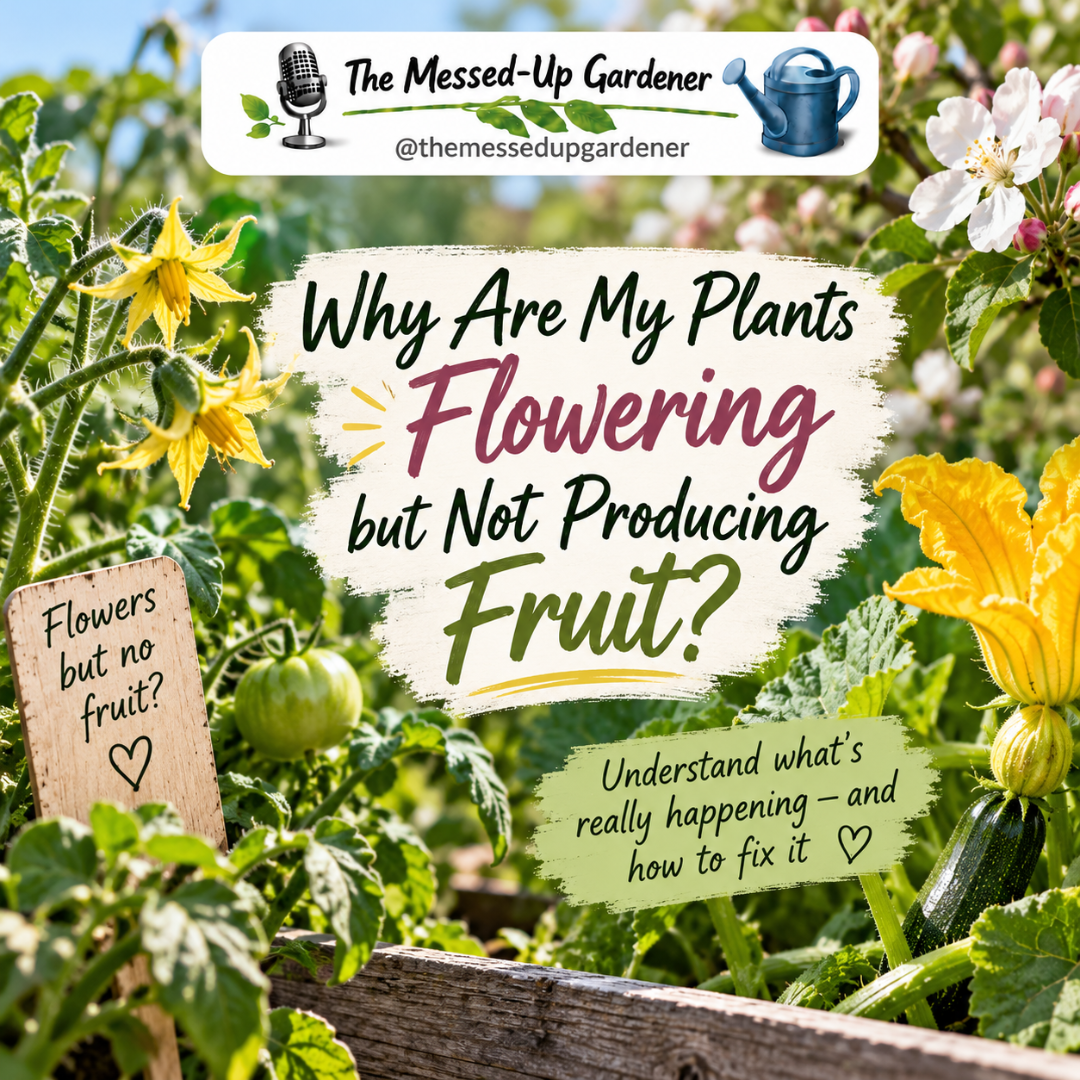
Ep 192: Why Flowers Appear but Fruit Never Follows – The Messed Up Gardener
Your plant is covered in flowers.
The bees are visiting. Everything looks healthy. You start imagining tomatoes, courgettes, pumpkins or bowls full of berries.
Then the flowers fall off.
And no fruit follows.
It is one of those frustrating gardening problems that makes you wonder whether the bees are missing, the weather is wrong, the plant needs fertiliser — or the whole thing simply isn’t working.
But flowers are only the beginning of fruit production.
Between a flower opening and a fruit reaching your kitchen, several things need to happen. Pollination needs to occur, fertilisation needs to succeed, conditions need to be suitable, and the plant needs enough resources to continue supporting the developing fruit.
So if your plants are flowering but not producing fruit, the best place to start isn’t with a bottle of fertiliser.
It is with the flower itself.
Not Every Flower Can Become Fruit
This is particularly important with courgettes, pumpkins, cucumbers, squash and melons.
These plants produce separate male and female flowers.
Male flowers produce pollen. They usually sit on a narrow stem and will never develop into fruit.
Female flowers have a small swollen structure behind the petals. This is the ovary, and it has the potential to develop into fruit after successful pollination and fertilisation.
Early in the season, courgettes and pumpkins often produce several male flowers before female flowers begin appearing.
The flowers open beautifully and then drop off.
Nothing has gone wrong.
They were never going to become fruit.
So before worrying about blossom drop, check what kind of flower you are actually looking at.
Pollination and Fertilisation Are Different
Seeing bees visiting flowers is encouraging, but it doesn’t necessarily mean fruit will form.
Pollination is the movement of pollen onto a receptive stigma.
Fertilisation happens afterwards.
The pollen needs to be viable and compatible. The stigma needs to be receptive. The pollen grain then has to germinate and produce a pollen tube that reaches the ovule.
Only then can successful fertilisation occur.
This means you can have plenty of flowers and plenty of pollinator activity and still experience poor fruit set.
Incomplete pollination can also leave some recognisable clues.
A tiny courgette may begin to develop before yellowing and dropping. Strawberries may become misshapen. Corn cobs may have gaps where kernels failed to develop.
That little courgette behind the flower can be particularly misleading because the swollen ovary is already present before pollination occurs.
It looks like a baby courgette.
But successful fruit development hasn’t necessarily started yet.
Different Crops Pollinate Differently
Understanding how your particular crop moves pollen makes diagnosing problems much easier.
Tomatoes and peppers commonly self-pollinate, although movement and vibration help release pollen inside the flower. Outdoors, wind and insects usually provide enough movement. In a sheltered greenhouse, gently tapping the plant support or flower cluster may help.
Courgettes, pumpkins and cucumbers need pollen transferred from a male flower to a female flower.
If pollinators are scarce, you can hand-pollinate by transferring pollen from a freshly opened male flower onto the stigma of a freshly opened female flower.
Corn relies primarily on wind.
Pollen falls from the tassels onto the silks, with each silk connected to a potential kernel. This is why corn generally performs better when planted in blocks rather than one long row.
Fruit trees introduce another consideration: compatible pollen.
Apples, pears, plums, cherries, blueberries and kiwifruit may require or benefit from another compatible plant flowering at the same time.
Having two plants nearby doesn’t automatically solve the problem if their flowering periods don’t overlap or the varieties aren’t compatible.
Weather Can Interrupt Fruit Set
Flowers are sensitive.
The rest of the plant can look perfectly healthy while temperature is interfering with pollen production, pollen viability, stigma receptivity or fertilisation.
Extreme heat can reduce pollen viability and shorten the period flowers remain receptive. Tomatoes, peppers and beans can all struggle to set fruit during very hot conditions.
Cold weather creates different problems.
Pollen tube growth can slow, pollinating insects may become less active and young fruit may abort.
Then there is rain and wind.
Heavy rain can interrupt pollinator activity, while strong winds can damage flowers. Sudden swings between warm and cold conditions can also interfere with successful fruit set.
Sometimes a plant will flower for weeks without producing much, then suddenly begin setting fruit once the weather settles.
The plant didn’t necessarily need another product.
It needed better conditions.
Check the Water Before Reaching for Fertiliser
Flowering and developing fruit require consistent access to water.
If soil becomes too dry, the plant prioritises survival. Flowers may dry prematurely and young fruit may be dropped.
But constantly wet soil isn’t the answer either.
Waterlogged soil reduces oxygen around the roots, affecting root function and nutrient uptake. The result can still be flower and fruit drop.
Containers are especially vulnerable because their smaller volume of growing mix can move from wet to dry surprisingly quickly.
Aim for consistency rather than extremes.
And don’t automatically assume a flowering plant needs more fertiliser.
Too much nitrogen can encourage masses of lush, dark green leaves at the expense of flowering and fruit production.
Fertiliser also cannot fix failed pollination, overheated flowers, incompatible pollen or waterlogged roots.
Sometimes Plants Simply Drop Fruit
Plants don’t have unlimited resources.
They need water, nutrients, healthy roots, adequate leaves and enough energy produced through photosynthesis to support developing fruit.
A plant may produce far more flowers than it could ever carry to maturity.
Citrus trees are a great example. They can produce huge numbers of flowers, begin developing many tiny fruits and then shed a significant proportion of them.
The tree is effectively adjusting the crop to what it can support.
Some flower and young fruit drop is completely normal.

A Simple Flower-to-Fruit Check
If your plants are flowering but not producing fruit, resist the temptation to immediately feed, spray or water them.
Instead, investigate.
Is the flower male, female or both?
How does this crop normally move pollen?
Are the necessary pollinators or compatible plants available?
What has the weather been doing while the flowers are open?
And most importantly, watch what happens next.
Does the flower simply fall away?
Does a tiny fruit begin developing and then stop?
Is the plant excessively leafy?
Is the soil dry or waterlogged?
Are developing fruits misshapen?
Those clues can help identify which stage of the flower-to-fruit process is being interrupted.
Flowers Are a Promise, Not a Guarantee
Seeing a garden full of flowers is exciting, but flowering is only the beginning.
The right flower needs to open.
Compatible pollen needs to reach it.
Fertilisation needs to succeed.
Conditions need to cooperate.
And the plant needs enough resources to support what happens next.
So the next time flowers start dropping without a harvest following behind them, don’t immediately blame the bees or reach for fertiliser.
Ask one much more useful question:
Which stage between flower and fruit did this plant actually reach?
Once you know that, you are much closer to understanding what your plant actually needs.
🍄 Grow Your Own Gourmet Mushrooms at Home
If growing food is your thing, why stop at the vegetable garden?
Through Mushrooms By The Sea, I grow and supply gourmet mushroom grow kits here in New Zealand, making it easy to experience growing your own mushrooms at home.
Listeners and readers of The Messed-Up Gardener can receive 10% off their first full-priced order using the code SHROOM10 at checkout.
Visit www.mushroomsbythesea.co.nz to explore the range.
Discount applies to full-priced items only and cannot be used on products already on sale or discounted.
Until next time, remember…
Gardening can happen in any space, in any place, and on any budget.
Esther Williams
The Messed-Up Gardener
Leave a Reply