By Esther Williams

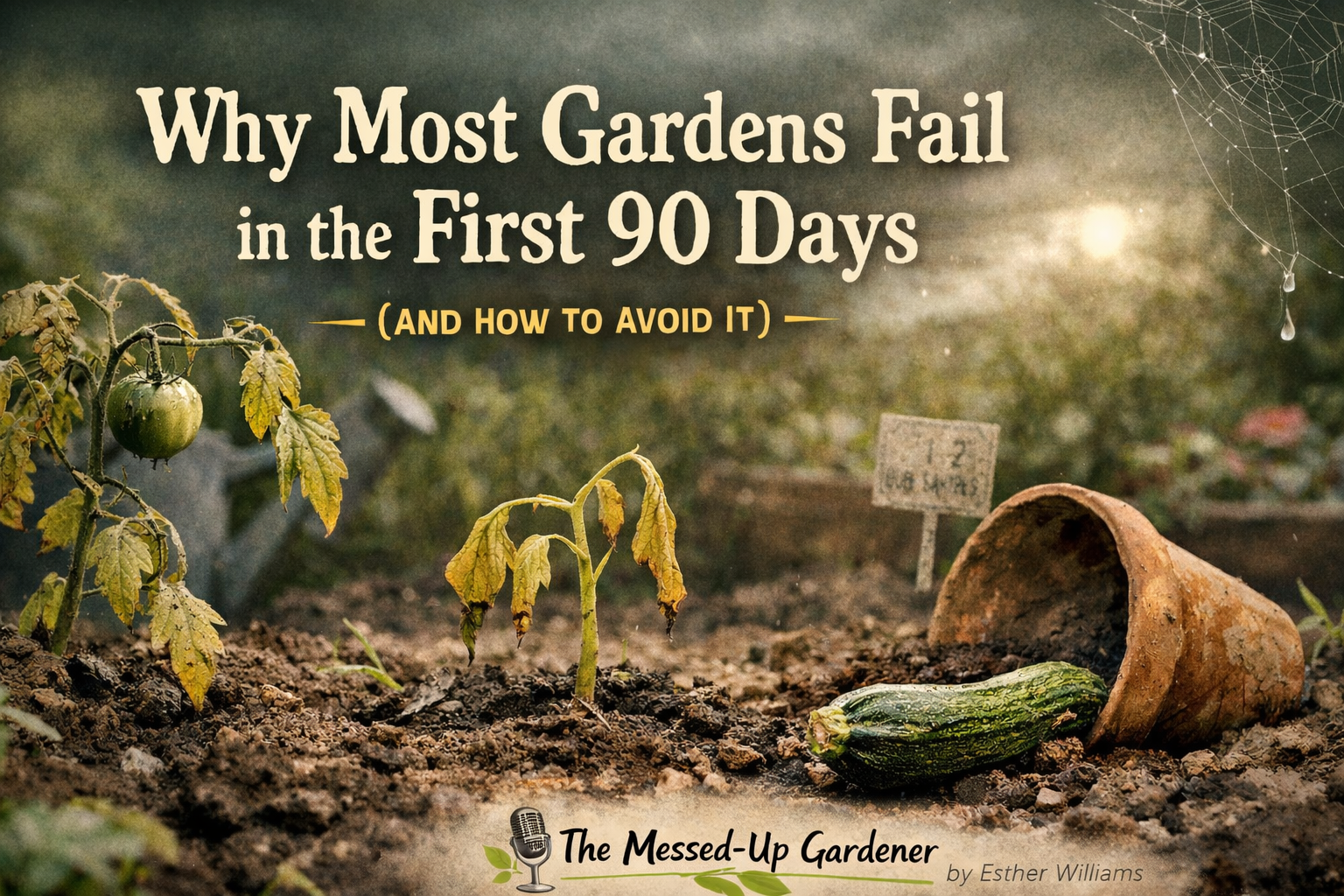
Ep 173: Why Most Gardens Fail in the First 90 Days (And How to Avoid It) – The Messed Up Gardener
Most gardens don’t fail at the end of the season.
They start to struggle much earlier than that.
In many cases, the first signs show up within the first 30 to 90 days — and they’re often subtle enough to be misunderstood.
Growth slows.
Plants stop responding the way you expected.
And small issues begin to stack up.
At that point, it’s not always obvious what’s causing it.
So people try to fix things.
They water more.
They adjust conditions.
They make changes.
But instead of improving, the garden often becomes more unpredictable.
And that’s where many gardens start to lose direction.
The False Start Phase (Days 0–14)
At the beginning, everything looks like it’s working.
Seeds germinate.
Seedlings emerge.
Growth appears strong and consistent.
This creates a sense of confidence — because visually, it feels like success.
But early growth can be misleading.
In the first 1–2 weeks, plants rely heavily on energy stored within the seed. They’re not yet fully dependent on your soil, your watering habits, or your environment.
So even if your setup isn’t quite right, everything can still look fine.
This is the easiest stage of gardening — but it’s also the most misunderstood.
Because the system hasn’t been tested yet.
The First Dip (Days 14–30)
This is where things begin to change.
Growth slows.
Leaves may lose some vibrancy.
Plants don’t progress as quickly as expected.
And this is often where people start to worry.
But this stage is not failure.
It’s transition.
Plants are now becoming fully dependent on their environment. They need consistent moisture, access to nutrients, and stable growing conditions.
If any of those are slightly off, you’ll start to see it.
This is the moment where gardening shifts from planting… to understanding.
The Mistake Window (The Turning Point)
This is where most gardens go off track.
Not because people stop caring.
But because they react too quickly.
When something looks off, the instinct is to fix it.
So people:
- Water more (or less)
- Move plants
- Add fertiliser
- Change conditions
Each of these actions may seem logical.
But when multiple changes happen at once, the system becomes unstable.
Plants are no longer responding to one condition — they’re responding to many.
And that makes the garden difficult to read.
👉 The key insight:
Most gardens don’t fail from neglect.
They fail from overreaction.
The System Lag Effect
One of the most confusing parts of gardening is that nothing responds instantly.
Water takes time to move through soil.
Nutrients take time to be absorbed.
Growth reflects past conditions, not current ones.
What you see today is often the result of what happened days ago.
So when people make a change and don’t see immediate results, they assume it didn’t work.
And they change something else.
This creates overlapping responses, making it harder to understand what’s actually happening.
But once you understand that gardens operate with a delay, everything becomes clearer.
Instead of reacting immediately, you observe.
You allow time for changes to take effect.
And you begin to recognise patterns.
The Confidence Drop (Days 30–60)
By this stage, expectations begin to settle.
And often, there’s a gap between what people expected… and what they’re seeing.
The garden doesn’t feel as exciting.
Results don’t match the effort.
Progress feels inconsistent.
This is where confidence starts to drop.
People begin to question themselves:
“Am I doing this right?”
“Should this be working better by now?”
And this is where many gardens start to stall.
Not because the system isn’t working — but because confidence is.
Because beneath the surface, the system is still developing:
Roots are expanding.
Soil is adjusting.
Plants are adapting.
But those changes aren’t immediately visible.
What Successful Gardeners Do Differently
The difference isn’t better conditions.
It’s better timing.
Successful gardeners:
- React less quickly
- Change fewer things at once
- Focus on consistency
- Observe patterns
They don’t try to fix everything.
They let the system stabilise.
And this creates clarity.
When fewer things are changing, it becomes easier to see what’s working.
And that’s where confidence rebuilds.
The 90-Day Turning Point
By around 90 days, things begin to shift again.
Roots are established.
Soil has started to balance.
Growth becomes more consistent.
For the first time, the garden feels more reliable.
And this changes how you approach it.
You stop reacting to every small issue.
You start working with what’s already there.
And the garden begins to feel like a system — not just a collection of plants.

A Simple 90-Day Framework
If you want to avoid the stage where most gardens fail, keep this simple:
Start simple.
Stay consistent.
Change slowly.
Observe before reacting.
Build on what’s working.
Because in the first 90 days, your job isn’t to perfect your garden.
It’s to guide it through its stages.
The Real Lesson
Most gardens don’t fail because people don’t care.
They don’t fail because gardening is too difficult.
They struggle because people don’t realise what stage they’re in.
They expect results too early.
They respond too quickly.
And they lose confidence at the exact point where the system is still forming.
But once you understand that…
everything changes.
Because instead of questioning every step, you start recognising the process.
And when you stay with it long enough…
that’s when things begin to work.
The first 90 days of a garden aren’t about results.
They’re about understanding.
Because once you understand how your garden develops…
you stop trying to force it.
And you start building something that actually works.
Until next time, remember:
Gardening can happen in any space, in any place, and on any budget. 🌿
Have an incredibly abundant week — and I’ll buzz you later.
Happy gardening
Esther Williams
The Messed Up Gardener
Leave a Reply