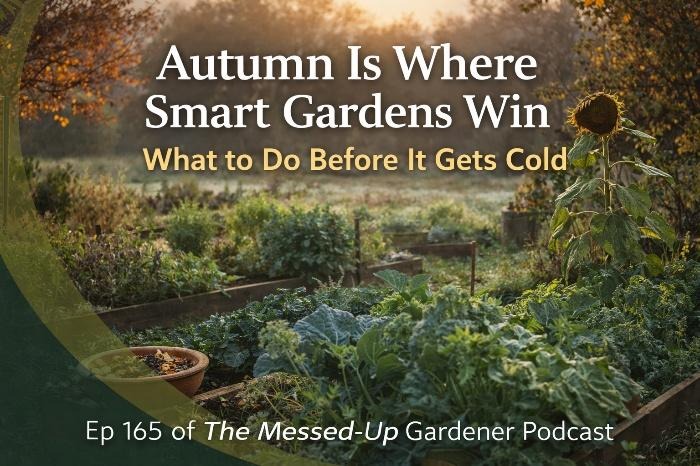
What to Do Before It Gets Cold

Ep 165: Autumn Is Where Smart Gardens Win – What to Do Before It Gets Cold – The Messed Up Gardener
Autumn isn’t the end of the gardening season.
It’s leverage season.
The gardeners who feel calm and capable in winter didn’t suddenly get organised in July. They made steady, strategic decisions in autumn.
If your garden feels slightly tired, uneven, or chaotic right now — that’s completely normal. But what you do in the next 60 days will determine how manageable winter feels.
No hype.
No overwhelm.
Just preparation.
Because winter doesn’t defeat gardeners.
Winter reveals preparation.
The Autumn Mindset Shift
Most gardeners treat autumn like tidy-up season.
We pull things out.
Clear beds aggressively.
Cut everything back.
Assume productivity is over.
But biologically, autumn is not a shutdown.
- Soil is still warm
- Microbes are still active
- Roots are still growing
- Moisture patterns are shifting
- Light levels are dropping gradually
This is what I call the quiet productivity window.
Above ground, things slow down.
Below ground, life continues working.
Autumn isn’t about squeezing out one last harvest.
It’s about:
- Banking soil health
- Establishing cool-season crops
- Improving drainage
- Strengthening systems
Gardens don’t fail in winter.
They struggle because autumn preparation was rushed, skipped, or misunderstood.
Autumn is a design season — not a decline season.
Approach it calmly and winter becomes manageable instead of stressful.
The Five Autumn Moves Smart Gardeners Make
These aren’t dramatic.
They aren’t complicated.
But they compound.
1. Feed the Soil, Not the Leaves
In spring and summer, we feed for growth.
In autumn, we feed for structure.
Now is the time to:
- Add compost
- Apply light organic mulch
- Chop and drop finished plants
- Add well-aged manure
- Build slow-release fertility
Autumn feeding is about soil biology.
Soil life doesn’t stop when temperatures drop. Early autumn warmth allows microbes and fungi to continue breaking down organic matter. By late winter and early spring, nutrients are already in a more plant-available form.
If you wait until late winter, you’re asking biology to work in cold soil.
Autumn feeding is long-term thinking.
2. Establish Cool-Season Crops Early
Many gardeners wait until it feels cold.
That’s too late.
Cool-season crops like:
- Spinach
- Kale
- Silverbeet
- Broccoli
- Cabbage
- Carrots
- Broad beans
don’t mind cooler air — but seedlings need moderate soil warmth to establish strong roots.
Winter harvest starts in autumn.
Once soil cools significantly, root development slows. A plant established in autumn tolerates cold far better than one planted mid-winter.
You’re not racing the cold.
You’re using the warmth that’s still available.
Two or three well-planted crops will outperform ten rushed ones.
Strategic gardening beats reactive gardening every time.
3. Prune Strategically, Not Emotionally
Autumn often triggers what I call revenge pruning.
Plants look tired. Leaves drop. Growth slows.
The instinct is to cut everything hard.
But heavy pruning now can stimulate soft new growth that won’t mature before cold weather.
Instead:
- Remove diseased or damaged growth
- Improve airflow
- Remove dead material
- Lightly shape if needed
Light pruning supports health.
Heavy pruning stimulates vulnerability.
Autumn is about hygiene and preparation — not drastic resets.
4. Fix Drainage Before the Rain Arrives
Winter damage rarely starts with frost.
It starts with waterlogging.
Roots don’t drown overnight. They suffocate slowly.
Poor drainage leads to:
- Root rot
- Fungal disease
- Nutrient lock-up
- Weak spring growth
In autumn:
- Raise beds if necessary
- Add organic matter to improve soil structure
- Loosen compacted areas
- Redirect water flow
- Check pots for blocked drainage holes
Cold soil already slows root metabolism. When oxygen is limited due to saturated soil, plants struggle. In spring, gardeners often add fertiliser — when the real issue was winter oxygen deprivation.
Drainage isn’t dramatic.
But it’s foundational.
5. Strengthen Microclimates
Autumn is the time to observe your garden closely.
Where does wind hit hardest?
Where does shade increase earlier?
Which corners cool down first?
Microclimates matter more in winter than in summer.
You can:
- Move pots closer to walls
- Add temporary windbreaks
- Prepare frost cloth early
- Relocate vulnerable plants
- Harvest sensitive crops
Positioning often outperforms protection.
A wall can retain warmth.
A fence can block wind.
A low corner can trap cold air.
Small adjustments now change survival outcomes later.

Common Autumn Mistakes
Autumn frustration usually comes from a few predictable patterns:
- Over-fertilising to push late growth
- Pulling everything out too early and leaving bare soil
- Ignoring irrigation adjustments as rainfall increases
- Leaving pests and diseased material to overwinter
- Trying to overhaul the entire garden in one weekend
Autumn is steady work.
If you feel busy but nothing improves, ask yourself:
Am I building soil, structure, and stability?
Or am I just clearing space?
Clarity reduces overwhelm.
The Calm Autumn Reset Checklist
If you want something practical, start here.
This week, check five areas:
Soil – Have I added compost or mulch?
Seeds – Have I planted at least two reliable cool-season crops?
Structure – Have I improved drainage?
Shelter – Have I adjusted positioning for exposure?
Systems – Have I reduced watering and removed diseased material?
You don’t need to do everything in one day.
Small, steady improvements compound.
The Long-Term Autumn System
Autumn preparation affects more than winter survival.
It shapes what happens six months from now.
- Diseased foliage left behind increases spring infection pressure
- Weed seed heads multiply next season’s workload
- Poor soil structure leads to compaction and nutrient leaching
Small autumn decisions compound.
Add organic matter now → Improve summer moisture balance.
Improve drainage now → Reduce root disease next season.
Gardening is seasonal.
Success is cumulative.
Autumn is where cumulative advantage begins.
The Long Game
Autumn gardening is quiet.
Less show.
Less dramatic growth.
Less social media appeal.
But this is where confident gardeners separate themselves — not through perfection, but through consistency.
When spring returns, gardens prepared in autumn respond faster:
- Stronger roots
- Healthier soil
- Less stress
Autumn preparation isn’t expensive.
It’s thoughtful.
It’s observational.
It’s steady.
No panic.
No rush.
Just preparation.
And remember:
Gardening can happen in any space, in any place, and on any budget. 🌿
Leave a Reply